

Crosses, amulets, and iconic symbols historically associated with faith and protection are making a comeback. Not only for their spiritual significance, but also for their aesthetic value.
High jewelry houses are revisiting the theme with a modern perspective.
Pomellato, for example, places the cross at the heart of the Bisanzio collection, with crosses adorned with colorful gemstones. Tiffany & Co. returns with designs by Jean Schlumberger. One of the most important jewelry designers of the 20th century, he redefined their design when he joined Tiffany & Co. in 1956. Meanwhile, Bvlgari offers rose gold versions with aquamarines, tourmalines, and diamonds.


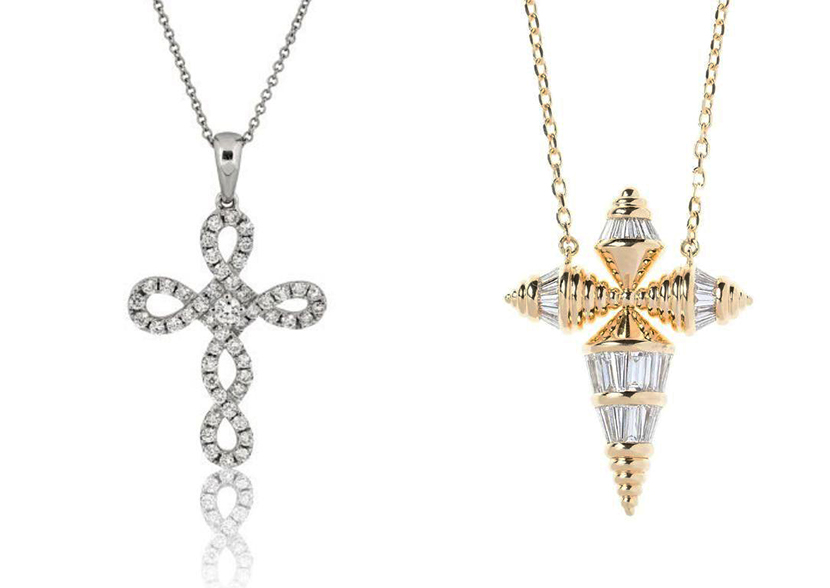
More and more jewelry designers are approaching the cross with a more contemporary outlook. Combining diamonds with dark metals, creating pieces that move between sculptural, minimalist, and sometimes gothic.
The trend isn't limited to the large international houses. On the Greek scene of contemporary jewelry making, the interest in symbols with deeper meaning is also evident.
Nikos Koulis, for example, approaches jewelry as an architectural form, where geometry and light substitute for direct symbolism, creating pieces that exude power. Kessaris maintains a more direct connection to tradition, incorporating timeless, diamond-embellished motifs into contemporary creations that balance between the classic and the current.
Lito Fine Jewelry, on the other hand, with its strong use of symbols, such as the eye. It highlights the timeless need for jewelry that functions not only as decorative elements but also as personal «talismans.» In these cases, the meaning is left to be shaped by the wearer themselves.
The Greek approach differentiates itself precisely at this point. The symbols may not be stripped of their religious interpretation, as one might expect. But at the same time, they re-emerge as elements of cultural memory and personal identity. The jewelry thus becomes an object that balances between aesthetics, tradition, and individual interpretation.
In the market for collectible jewelry,.


When history becomes relevant again
Part of the trend is also attributed to the return of early 2000s aesthetics, where similar symbols had a strong presence. However, the current version appears more mature and layered. It's not just a revival, but a redefinition.
The same dynamic was recently reinforced by an event that brought the issue back into the spotlight in a tangible way. A striking amethyst and diamond cross, by Garrard, which Princess Diana had worn repeatedly in the late 1980s, was put up for auction by Sotheby's in London, drawing intense interest.
The jewel, known as the 1920s Attallah Cross, sold for 163,800 pounds (193,000 euros), a price that, according to the house's experts, may be a record for a cross.
Its aesthetic value played a decisive role, as did its provenance, since the connection with Diana continues to lend particular weight to any object associated with her image. The winning bid came from Kim Kardashian, who in recent years has systematically invested in items linked to iconic figures of the 20th century.
This auction also serves as an indication of a broader comeback for the cross, recalling its strong presence in the 1990s and early 2000s, when figures like Drew Barrymore and Cindy Crawford systematically incorporated it into their style. At the core of this aesthetic remains Madonna, from her *Like a Virgin* (1984) era, who helped establish the cross as a styling element.


However, the question today is more complex: can one wear a cross purely as an aesthetic choice without touching on issues of cultural or religious sensitivity? According to Michael Coan, professor of jewelry design at the Fashion Institute of Technology, the cross is not exclusively a Christian symbol. The shape has appeared since prehistory and in different cultures has been associated with (or interpreted as representing) concepts such as the four points of the compass or the four elements of nature, which also explains its timeless, almost universal appeal. This allows designers to approach the motif as an «open» symbol, capable of appealing to different audiences.
At the same time, collections that draw inspiration from different traditions, from the Egyptian ankh cross to the infinity symbol of Eastern religions, show that the interest is not limited to a single faith, but extends to a broader system of symbolism.
In this context, the cross returns as an object with special weight, aesthetic, historical, but also collectible significance. Its return is not just about fashion, but about value: an object that gains meaning through its history and its place in the present.
Source: newmoney.gr


